
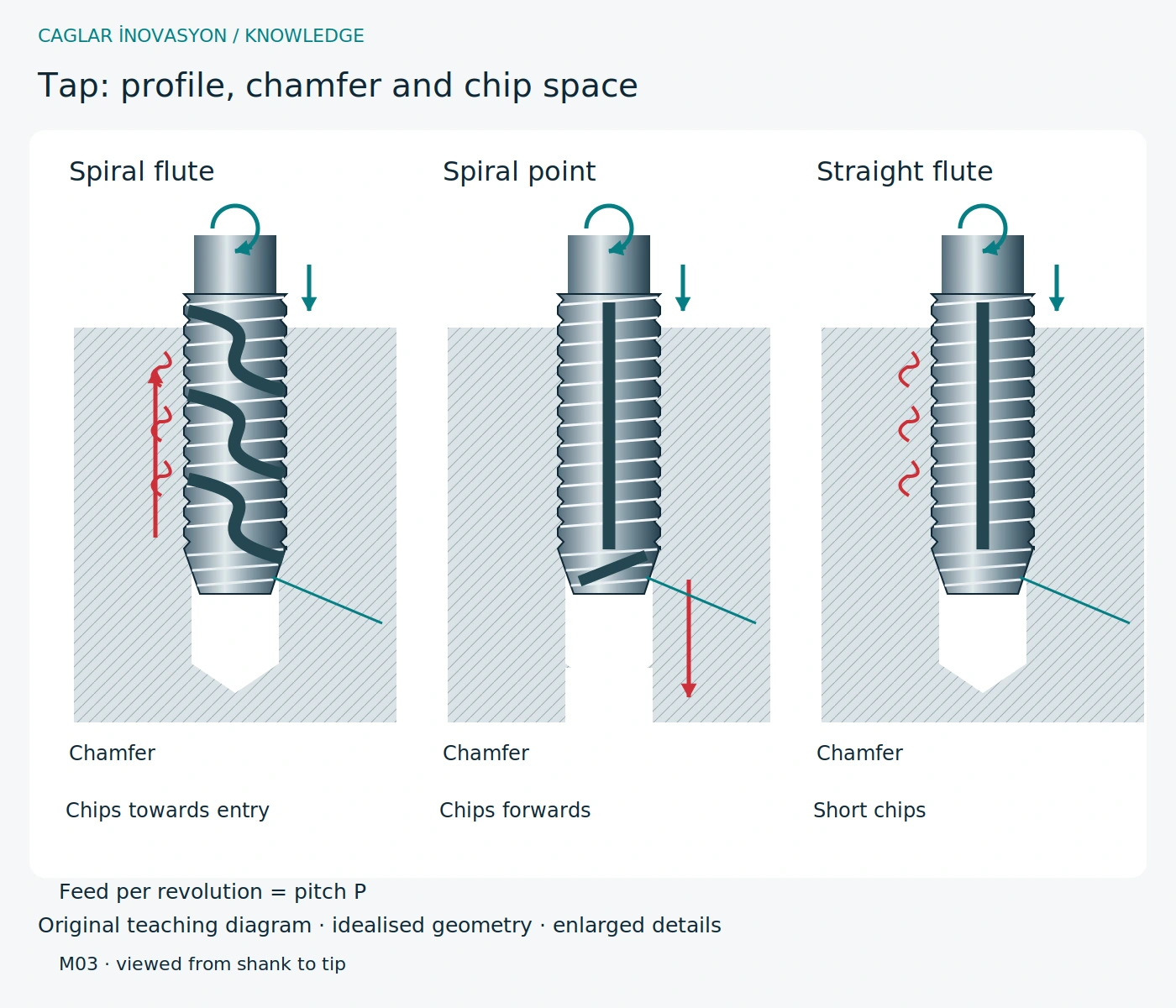
Pilot hole, chamfer and thread profile
The illustrated tap exceeds the pilot-hole diameter only by the amount required to generate the profile. Chamfer teeth generate it progressively; the full-profile portion guides and sizes. In a purely illustrative M10 × 1.5 metric cutting example, D − P gives an approximate 8.5 mm pilot diameter. This is not a release specification: tolerance, material and supplier dimensions govern. Form tapping requires a different, generally larger and more tightly controlled pilot hole. The single-start right-hand example uses M03 on entry with axial feed per revolution equal to pitch; withdrawal requires synchronised reversal.
Basic principle
For long-chipping materials, spiral-flute taps are often used in blind holes to bring chips back towards the entry. A spiral-point tap sends chips forward and needs clearance ahead, typically in a through hole.
Key relationships
Straight flutes are used, among other applications, for short-chipping materials. Flute shape alone does not establish suitability: helix, tool material, coating and chamfer must be considered together. A forming tap is not a cutting tap despite a similar outline.
Selection and limitations
The chamfer is the lead-in section with progressively increasing thread profile. Common catalogue designations include A: long, B: spiral point, C: short and E: very short. Check the exact number of chamfer threads in the manufacturer data. A short chamfer gets full threads closer to the bottom but shares cutting across fewer teeth.
Practical checks
Distinguish useful thread depth from drilled depth in an enquiry. State material, blind or through hole, chip clearance, thread standard and coolant. Repeated breakage near the bottom may also result from chip packing or insufficient clearance.
Benefits and limitations
Directed chip transport can stabilise tapping. Spiral flutes help bring chips back, while spiral points need space ahead. A very short chamfer saves run-out distance but distributes cutting over fewer lead teeth.
Practical example · not a customer performance claim
Example: two components have the same nominal thread, one through and one blind. Diameter alone does not justify using the same tap. Check chip space, full thread length and useful drilled depth separately.
Comparing alternatives
Chamfer form and flute shape are different properties. Do not order A, B, C, D or E by letter alone: check catalogue/standard version, actual lead length and application.
Common problems, causes and remedies
These steps are a diagnostic workflow, not a confirmed remote diagnosis. Retest under controlled conditions after a change.
| Step | Check and action |
|---|---|
| Recognise | Chip nests at entry or packed chips at the bottom |
| Possible causes | Unsuitable chip direction, geometry or lubrication |
| Isolate systematically | Record chip location, flute condition and hole type; compare the tool data |
| Corrective action | Match geometry to hole/material; ensure chip space and fluid supply |
| Prevent recurrence | Record tool identifier and hole type; never substitute by thread size alone |
Problem – cause – action at a glance
Use the diagnostic checks above before taking action. One symptom does not prove one specific cause.
| Problem | Possible cause | Recommended action |
|---|---|---|
| Chip nests at entry or packed chips at the bottom | Unsuitable chip direction, geometry or lubrication | Match geometry to hole/material; ensure chip space and fluid supply |