
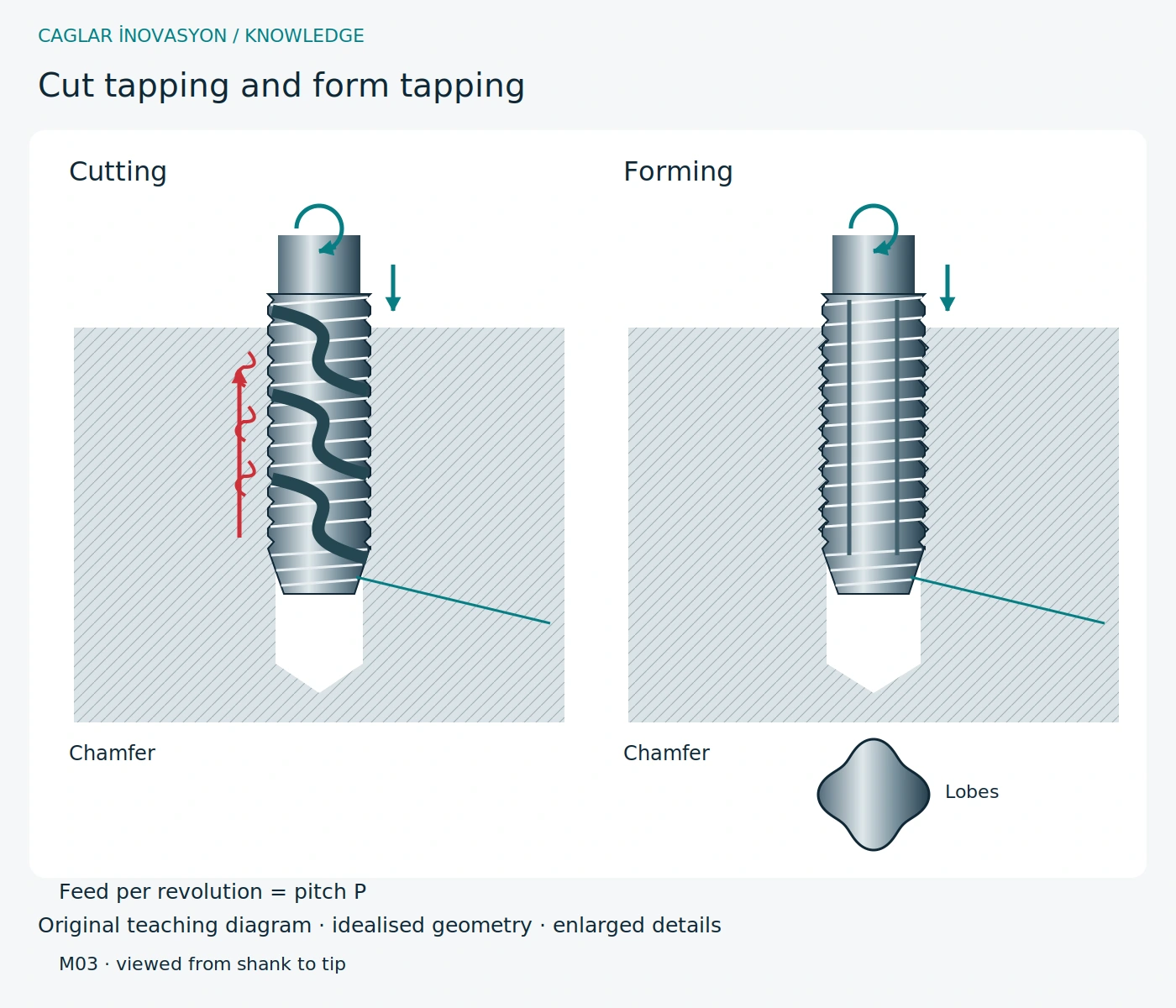
Cutting and forming towards the same thread
A cutting tap has flutes and cutting edges. A forming tap displaces sufficiently ductile material using lobes; lubrication grooves are not chip flutes. The formed crest may show a fold. Pilot diameter, ductility, lubrication and available torque must suit the process. Chipless does not mean force-free or suitable for every material.
Basic principle
A cutting tap produces the thread by removing chips. A forming tap plastically displaces material without cutting chips. Form tapping requires a suitable material with sufficient ductility.
Key relationships
Do not transfer the pre-hole specification from cutting to forming without checking it. In forming, pre-hole diameter and tolerance control profile fill and affect torque. Select dimensions and lubrication from the tool specification.
Selection and limitations
Specify thread size, pitch, tolerance and useful thread depth. Drilled depth is not the same as full thread length: chamfer, tool tip and clearance require space. Check synchronisation and the appropriate tapping cycle.
Practical checks
Inspect the finished thread using the specified method; examine the profile separately when profile fill is a requirement. A visible thread alone proves neither dimensional accuracy nor load capacity. Thread milling is another option but requires its own tooling and programming approach.
Benefits and limitations
Cut tapping is widely applicable but creates chips. Form tapping avoids cutting chips in suitable ductile materials; pre-hole control and lubrication are particularly important. It is not a general replacement for brittle materials.
Practical example · not a customer performance claim
Example: residual chips in a blind hole disturb assembly. Consider form tapping as well as improved chip evacuation, provided material, thread requirements and pre-hole capability fit. Inspect a sample profile and the agreed thread gauge.
Comparing alternatives
Thread milling offers different diameter-adjustment and chip-control options but needs a suitable CNC path. Compare batch size, tool cost, cycle time and inspection.
Common problems, causes and remedies
These steps are a diagnostic workflow, not a confirmed remote diagnosis. Retest under controlled conditions after a change.
| Step | Check and action |
|---|---|
| Recognise | Tight thread or tool breakage near the bottom |
| Possible causes | Wrong pre-hole, packed chips, inadequate clearance, synchronisation error |
| Isolate systematically | Measure pre-hole and usable thread depth; compare cycle, chamfer and lubrication |
| Corrective action | Correct the cause, choose the proper tool and cycle, then inspect a new sample |
| Prevent recurrence | Monitor pre-hole and thread together; revalidate process changes |
Problem – cause – action at a glance
Use the diagnostic checks above before taking action. One symptom does not prove one specific cause.
| Problem | Possible cause | Recommended action |
|---|---|---|
| Tight thread or tool breakage near the bottom | Wrong pre-hole, packed chips, inadequate clearance, synchronisation error | Correct the cause, choose the proper tool and cycle, then inspect a new sample |