
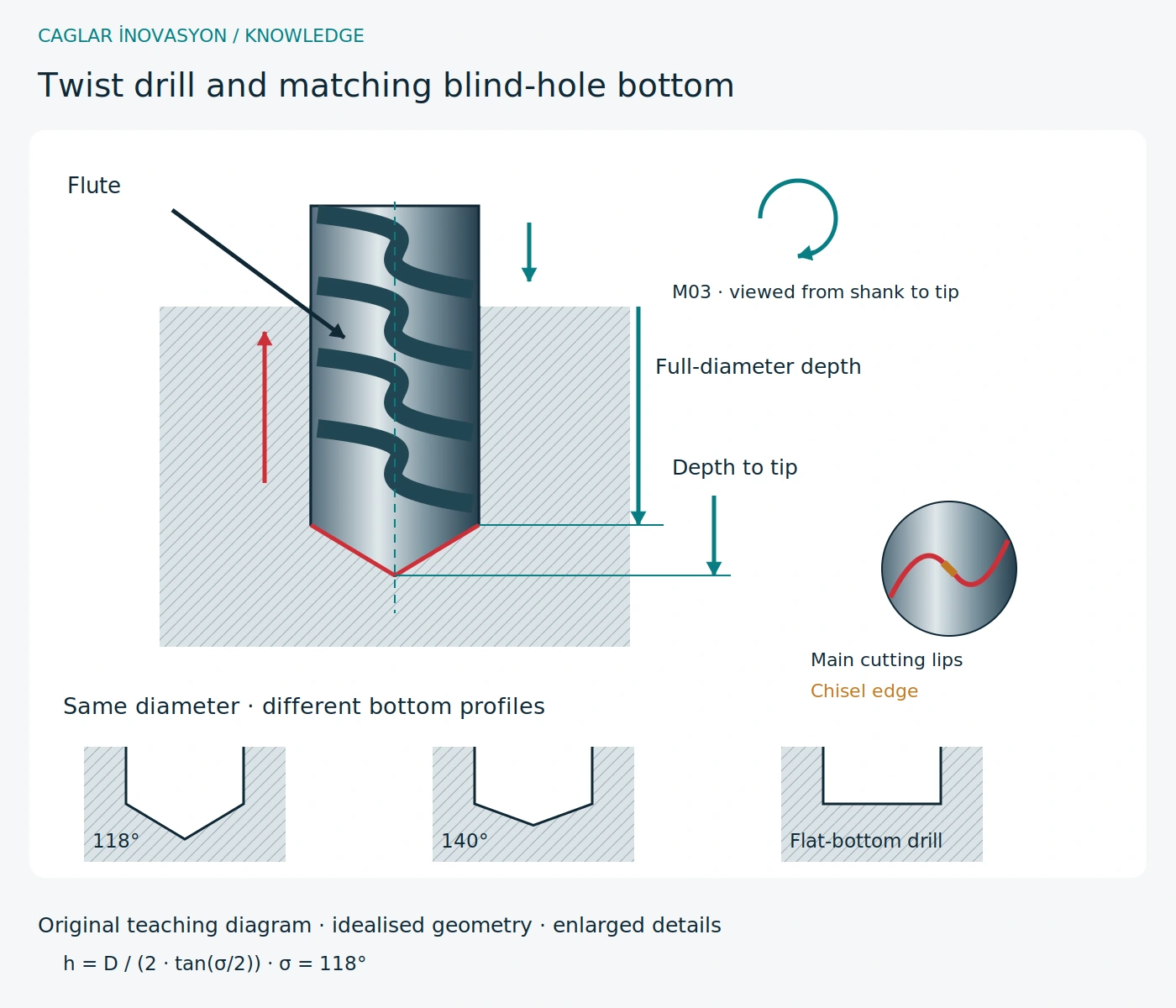
Drill point and blind-hole bottom must agree
The section shows an idealised twist drill with a 118° included point angle and a matching conical blind-hole bottom. A 140° example has a shorter point at the same diameter; a suitable flat-bottom drill produces another base shape. For the illustrated point, h = D / (2 · tan(σ/2)). Full-diameter depth differs from depth to the tip. Point thinning, chisel edge and regrinding alter the actual centre; mating faces may need a further operation.
Basic principle
A hole is defined by more than its diameter. Depth, entry, exit, cross holes and positional or size tolerances determine the demands. Required quality may call for a subsequent finishing operation.
Key relationships
Chip evacuation becomes more demanding with depth. Use sufficient working length without unnecessary overhang, which reduces stiffness. Internal coolant may help but needs the supply specified for the tool. Pressure alone does not establish adequate flow.
Selection and limitations
A universal pecking cycle is not a safe answer for every drill. Choose feed strategy, piloting and interruptions according to tool type and manufacturer guidance. Engagement and loading change at breakthrough or cross holes.
Practical checks
For troubleshooting, photograph the hole, chips and edges after the machine has stopped safely. Check runout, clamping, coolant and cutting data. Simply reducing speed does not remove a blocked flute.
Benefits and limitations
Drilling can make holes economically in series, but position, roundness and finish cannot be inferred from nominal drill size. Deep holes and inclined entries add demands.
Practical example · not a customer performance claim
Example: drill a fixture locating hole first. Whether reaming or boring follows depends on tolerance, position requirements and the initial hole. Reaming does not reliably correct a misplaced hole.
Comparing alternatives
Reaming can improve size and finish with a defined allowance. Boring may be more suitable for position or geometry correction. Both require suitable access and workholding.
Common problems, causes and remedies
These steps are a diagnostic workflow, not a confirmed remote diagnosis. Retest under controlled conditions after a change.
| Step | Check and action |
|---|---|
| Recognise | Oversize, wandering hole or long chips |
| Possible causes | Runout, inclined entry, unequal edges, poor evacuation |
| Isolate systematically | Measure the hole; check edges, holder and coolant separately |
| Corrective action | Correct holder or entry issues; review strategy and fluid supply against manufacturer guidance |
| Prevent recurrence | Monitor runout and regrind condition; plan dimensional and chip checks |
Problem – cause – action at a glance
Use the diagnostic checks above before taking action. One symptom does not prove one specific cause.
| Problem | Possible cause | Recommended action |
|---|---|---|
| Oversize, wandering hole or long chips | Runout, inclined entry, unequal edges, poor evacuation | Correct holder or entry issues; review strategy and fluid supply against manufacturer guidance |