
Basic principle
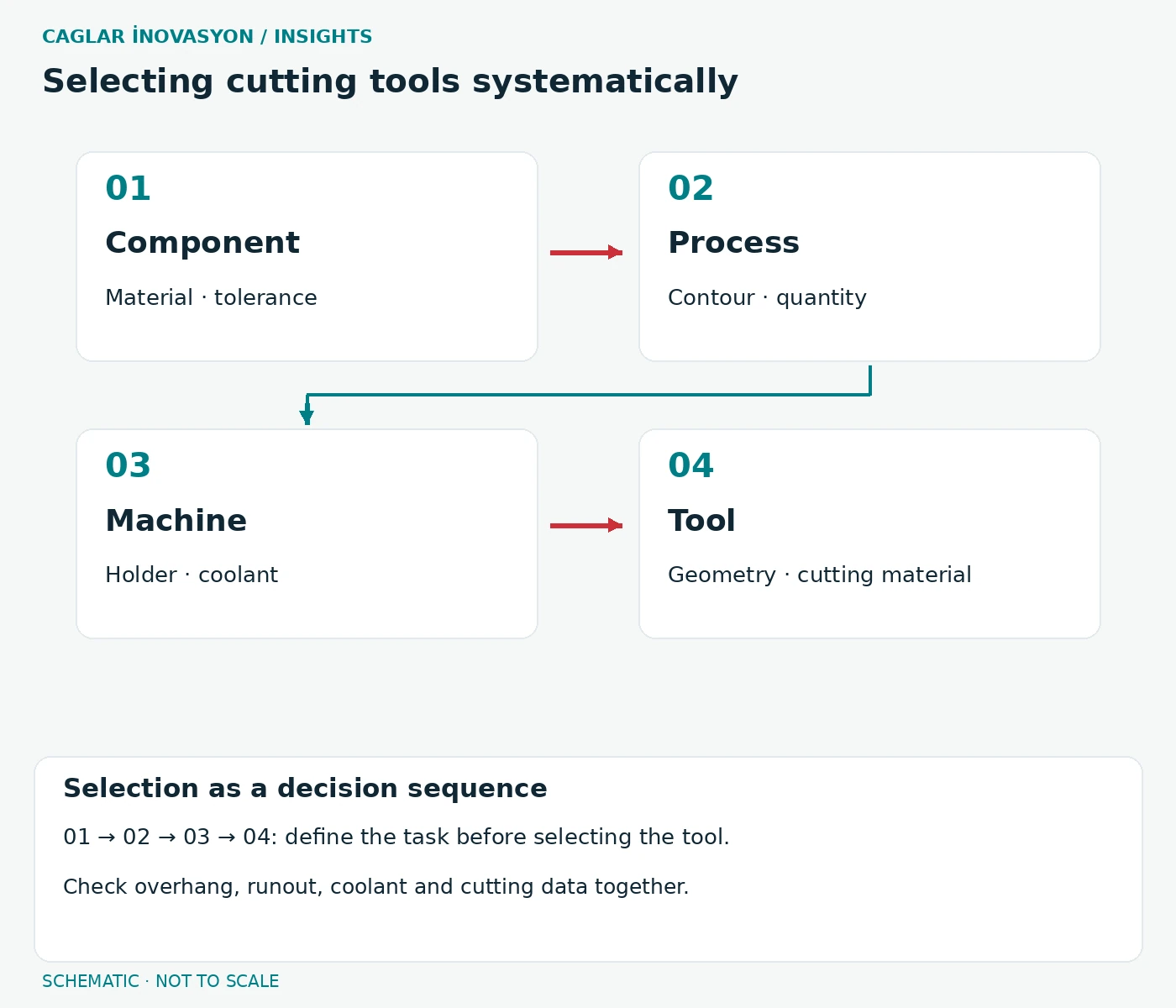
Start with the exact material and condition, contour, tolerance and quantity. Then select tool material, geometry and coating. A description such as “for steel” is too broad for a dependable decision.
Key relationships
HSS and carbide differ in toughness, hot hardness and usable operating conditions. Carbide is not automatically preferable in every unstable application. Edge geometry and the shortest practical tool projection matter too.
Selection and limitations
Check the holder, runout, speed range, torque, coolant supply and available space. Suitable cutting material cannot compensate for unsuitable clamping. Special options such as PCD or CBN require application-specific assessment.
Practical checks
Compare cost per good part rather than purchase price alone. Include life, regrinding, change time, scrap and machining time on the same basis. For an initial enquiry, a non-confidential task description and existing tool data are sufficient.
Benefits and limitations
Suitable selection can avoid unnecessary special tools and reduce change or scrap costs. A versatile tool reduces variety but is not necessarily optimal for every serial operation.
Practical example · not a customer performance claim
Example: assess a versatile drill for changing small batches and a dedicated geometry for a recurring production part. Compare cost per good part and repeatable quality rather than unit price.
Comparing alternatives
Standard tools, specials and regrinds differ in procurement, flexibility and process risk. Supply and replacement strategy belong in the technical decision.
Common problems, causes and remedies
These steps are a diagnostic workflow, not a confirmed remote diagnosis. Retest under controlled conditions after a change.
| Step | Check and action |
|---|---|
| Recognise | New grade lasts less than expected |
| Possible causes | Unequal trial conditions, wrong geometry, changed regrind |
| Isolate systematically | Compare old/new conditions including runout and material batch |
| Corrective action | Change one major variable; validate suitable edge/geometry using manufacturer data |
| Prevent recurrence | Document the approved tool, holder and process combination |
Problem – cause – action at a glance
Use the diagnostic checks above before taking action. One symptom does not prove one specific cause.
| Problem | Possible cause | Recommended action |
|---|---|---|
| New grade lasts less than expected | Unequal trial conditions, wrong geometry, changed regrind | Change one major variable; validate suitable edge/geometry using manufacturer data |