
Prefer climb milling on suitable CNC machines
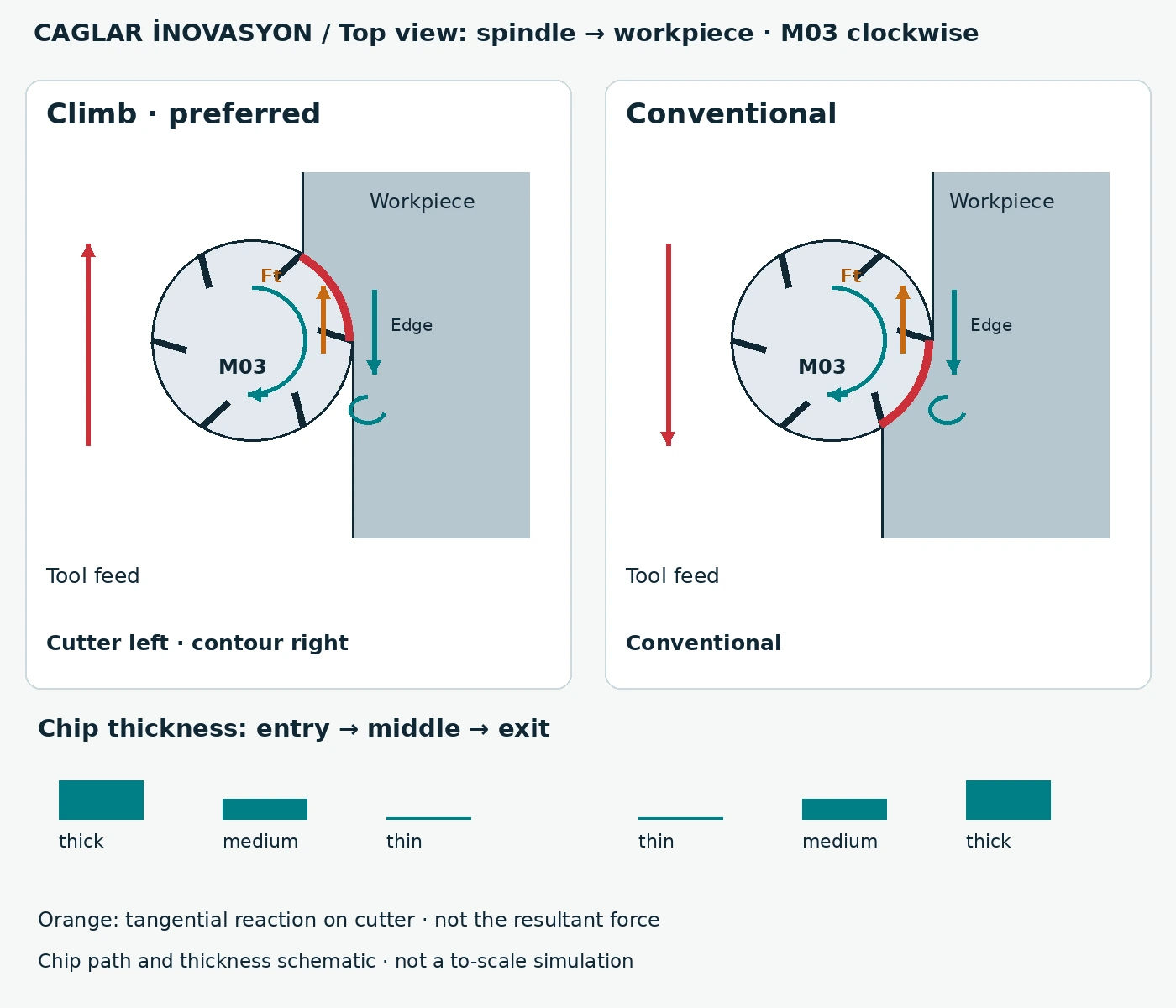
Climb milling is the preferred starting strategy on modern CNC machines with controlled backlash, sufficient rigidity and secure workholding. In idealised peripheral engagement, chip thickness decreases from entry to exit. The edge therefore starts cutting rather than initially rubbing the surface. Surface finish and tool life may benefit; no fixed improvement is promised. Significant backlash, unstable clamping or special surface conditions require review because pull-in forces may increase engagement unexpectedly.
Orientation: cutter left – contour right
With a clockwise cutter, place the cutter to the left of the contour when looking in its tool-feed direction. Imagine yourself at the cutter looking along its travel: the contour is on your right. This top view looks from the spindle towards the workpiece, so M03 appears clockwise. This rule applies to the shown side-contouring operation, not universally to full slots or every 3D path. This is a mental viewpoint, never a position inside a running machine.
Distinguish tool feed from table feed
The diagram shows tool feed relative to a fixed workpiece. At the right-hand contact, M03 edge motion is downward while climb-milling tool feed is upward. If table feed beneath a stationary tool is shown instead, the feed arrow reverses. Do not mix these reference frames. M04 reverses the side rule.
Climb and conventional milling compared
Both strategies use identical diameter and engagement. Force arrows show only the tangential reaction component on the cutter, not a calculated resultant or axial clamping force. Chips are schematic; actual shape depends on material, geometry and cutting conditions.
| Criterion | Climb · preferred | Conventional |
|---|---|---|
| Chip formation | Thick → thin | Thin → thick |
| Friction / heat | Less initial rubbing possible | Entry rubbing possible |
| Surface | Often favourable in a stable process | Rubbing or adhesion may interfere |
| Wear / life | Often favourable edge loading | Rubbing and thick exit can burden the edge |
| Forces | Account for pull-in effect | Account for separating components |
| Machine / fixture | Controlled backlash, rigid clamping | May be considered with problematic backlash |
| Applications | Default for suitable CNC contouring | Special cases per tool/process guidance |
Chip formation in three phases
Climb: thick entry, decreasing thickness, exit towards zero. Conventional: entry near zero, increasing thickness, thick exit. The detail strip uses normalised stages, not a time-accurate or to-scale chip-path simulation.
Benefits and limitations
With suitable machine conditions, climb milling can reduce rubbing at entry. Conventional milling can suit particular conditions but is not a universal chatter remedy. Both require secure clamping and support appropriate to the force direction.
Practical example · not a customer performance claim
Example: a housing wall shows chatter marks. Check wall support and overhang before reversing the milling direction. Compare paths at the same depth to separate direction from changed loading.
Comparing alternatives
For thin walls, cut sequence or reduced radial engagement can matter more than direction. Full-slot cutting cannot be classified as pure climb milling.
Common problems, causes and remedies
These steps are a diagnostic workflow, not a confirmed remote diagnosis. Retest under controlled conditions after a change.
| Step | Check and action |
|---|---|
| Recognise | Chatter marks or sudden pull-in |
| Possible causes | Compliance, backlash, changing engagement |
| Isolate systematically | Check workholding and backlash safely at standstill; compare path engagement |
| Corrective action | Correct backlash first; improve support and overhang, then run a documented trial |
| Prevent recurrence | Record the approved setup and path; inspect edges and finish at defined intervals |
Problem – cause – action at a glance
Use the diagnostic checks above before taking action. One symptom does not prove one specific cause.
| Problem | Possible cause | Recommended action |
|---|---|---|
| Chatter marks or sudden pull-in | Compliance, backlash, changing engagement | Correct backlash first; improve support and overhang, then run a documented trial |