
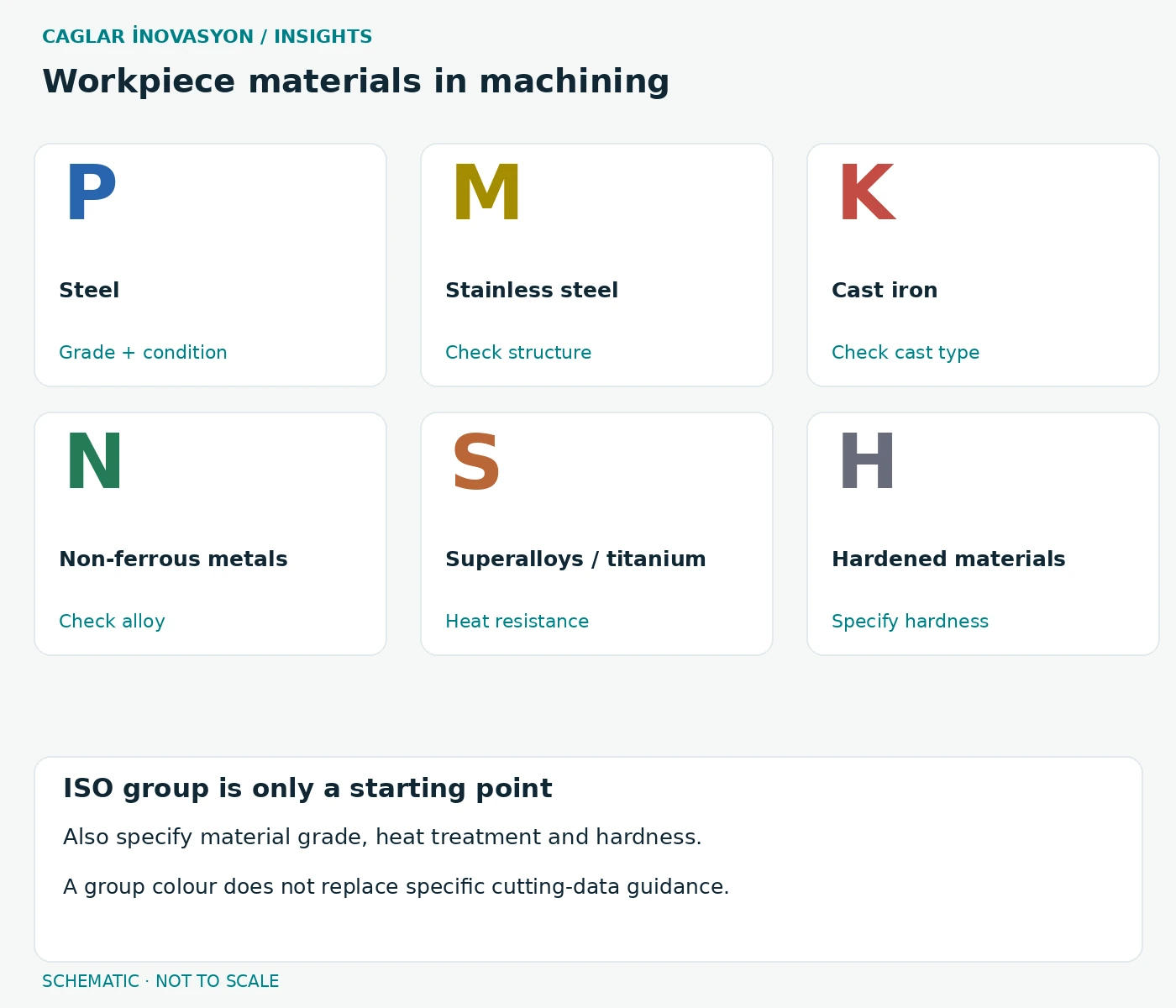
Basic principle
A material group is only a starting point. Alloy, microstructure and supply condition can change chip formation and tool loading. ISO application groups P, M, K, N, S and H help navigate tooling catalogues; they do not replace a material specification.
Key relationships
Steel, stainless steel, cast iron and aluminium alloys should not share one universal cutting-data set. Heat-treated steel may need different tooling from the same grade in a soft condition. “Stainless steel” does not yet define a machining task.
Selection and limitations
Record grade, hardness or strength, heat treatment and blank condition. A casting skin, weld or interrupted contour can impose additional demands. Compare process data and edge condition when material batches change.
Practical checks
Document the material and supply condition before changing tools or parameters in a trial. Without that baseline, a tool-life change can easily be attributed to the wrong cause. Clarify an uncertain designation from the drawing or material certificate first.
Benefits and limitations
Material grouping helps shortlist tools but does not replace grade and condition. Similar trade names can refer to different alloys; a harder batch can change a previously stable process.
Practical example · not a customer performance claim
Example: a steel part changes from soft supply to quenched-and-tempered condition. Do not reuse cutting data unchanged. Clarify hardness, allowance and tool range, then run a documented trial.
Comparing alternatives
With unclear specifications, identifying the material is more useful than random tool changes. Certificates and measurements provide different evidence from colour or chips alone.
Common problems, causes and remedies
These steps are a diagnostic workflow, not a confirmed remote diagnosis. Retest under controlled conditions after a change.
| Step | Check and action |
|---|---|
| Recognise | Unexpected tool-life change between batches |
| Possible causes | Hardness/microstructure, skin, inclusions or another process change |
| Isolate systematically | Compare certificates and hardness while checking tooling and machine condition |
| Corrective action | Resolve the deviation and revalidate suitable machining; avoid blanket speed increases |
| Prevent recurrence | Retain material condition and batch references in trial/quality records |
Problem – cause – action at a glance
Use the diagnostic checks above before taking action. One symptom does not prove one specific cause.
| Problem | Possible cause | Recommended action |
|---|---|---|
| Unexpected tool-life change between batches | Hardness/microstructure, skin, inclusions or another process change | Resolve the deviation and revalidate suitable machining; avoid blanket speed increases |