
How it works
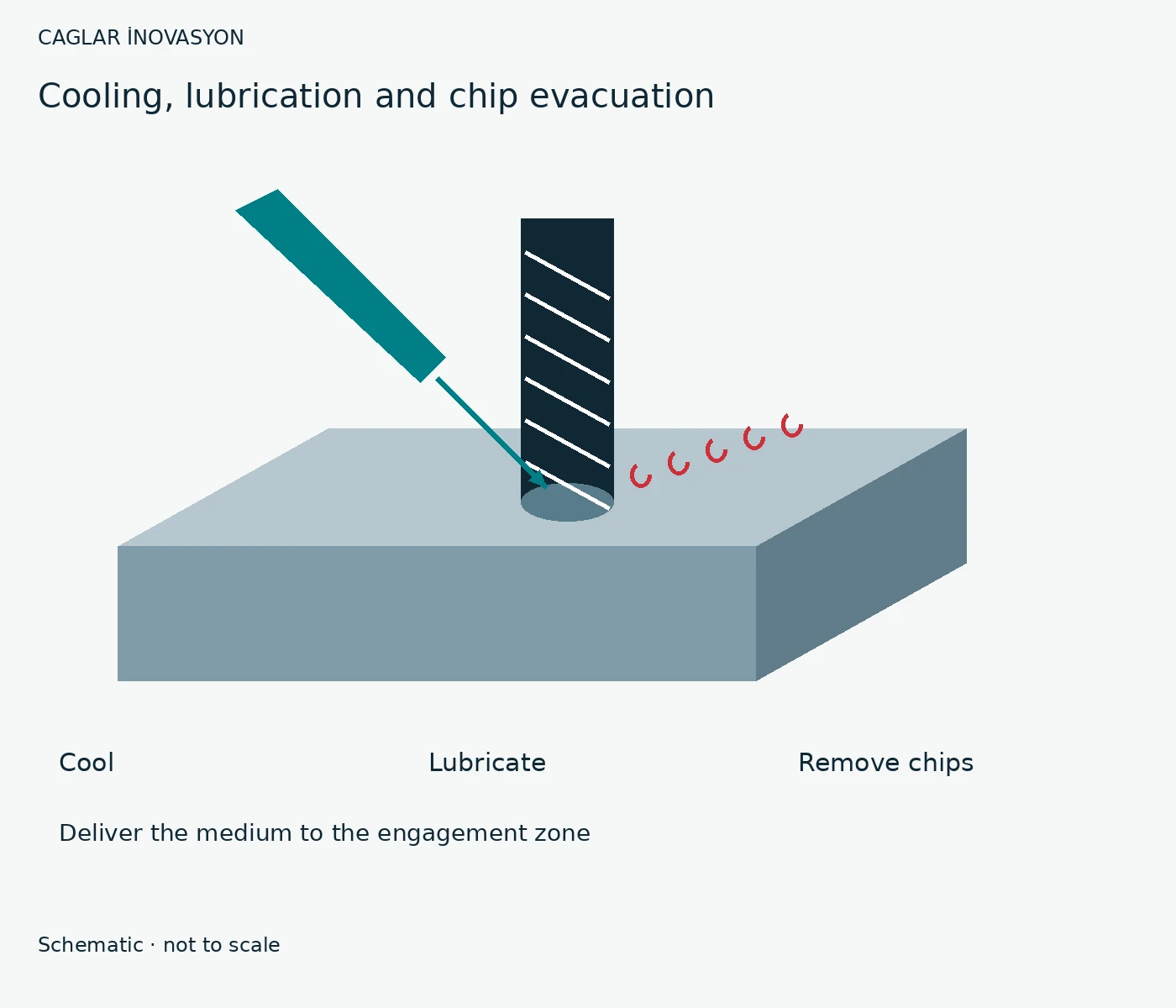
Cooling removes heat; lubrication affects friction and adhesion. A jet can also move chips away from the cut. Assess these three tasks separately. A large fluid volume does not by itself prove effective delivery to the edge.
Selection and requirements
Dry machining avoids a fluid circuit but needs suitable tools and controlled chip/dust removal. Flood and internal delivery can remove heat and chips, with appropriate media, filtration and maintenance. MQL delivers small lubricant quantities and does not automatically provide flood-cooling performance.
Benefits and limits
In interrupted milling, intermittent wetting can increase thermal loading. The choice depends on tool material, coating, workpiece and operation. A universal dry-or-wet rule is inappropriate.
Technical relationships
Check delivery at the cut: nozzle alignment, usable flow, filter condition and internal channels. Follow fluid supplier and workshop maintenance instructions. Do not select concentration, pressure or MQL quantity without application-specific guidance.
Practical example
Hypothetical example: chips are recut inside a deep pocket. Inspect the toolpath, accumulation location and delivery first. Change chip evacuation deliberately and compare surface quality under equivalent conditions. Increasing feed alone does not identify the cause.
Alternatives and checks
Compare dry, wet and MQL in controlled trials. Evaluate life, finish, dimensional stability, chip removal and fluid effort together. Control aerosols, dust and chips through suitable guarding and extraction.
Problems – causes – remedies
Possible causes only: observe and isolate first, change one factor and verify. Record effective measures as process standards.
| Problem | Possible cause | Check / remedy |
|---|---|---|
| Poor finish | Chip recutting or lubricant missing the cut | Inspect chip accumulation and nozzles; correct delivery/removal and inspect a comparison part. |
| Edge cracks | Possible thermal cycling | Record crack location; check wetting and tool suitability, stabilise delivery per manufacturer. |